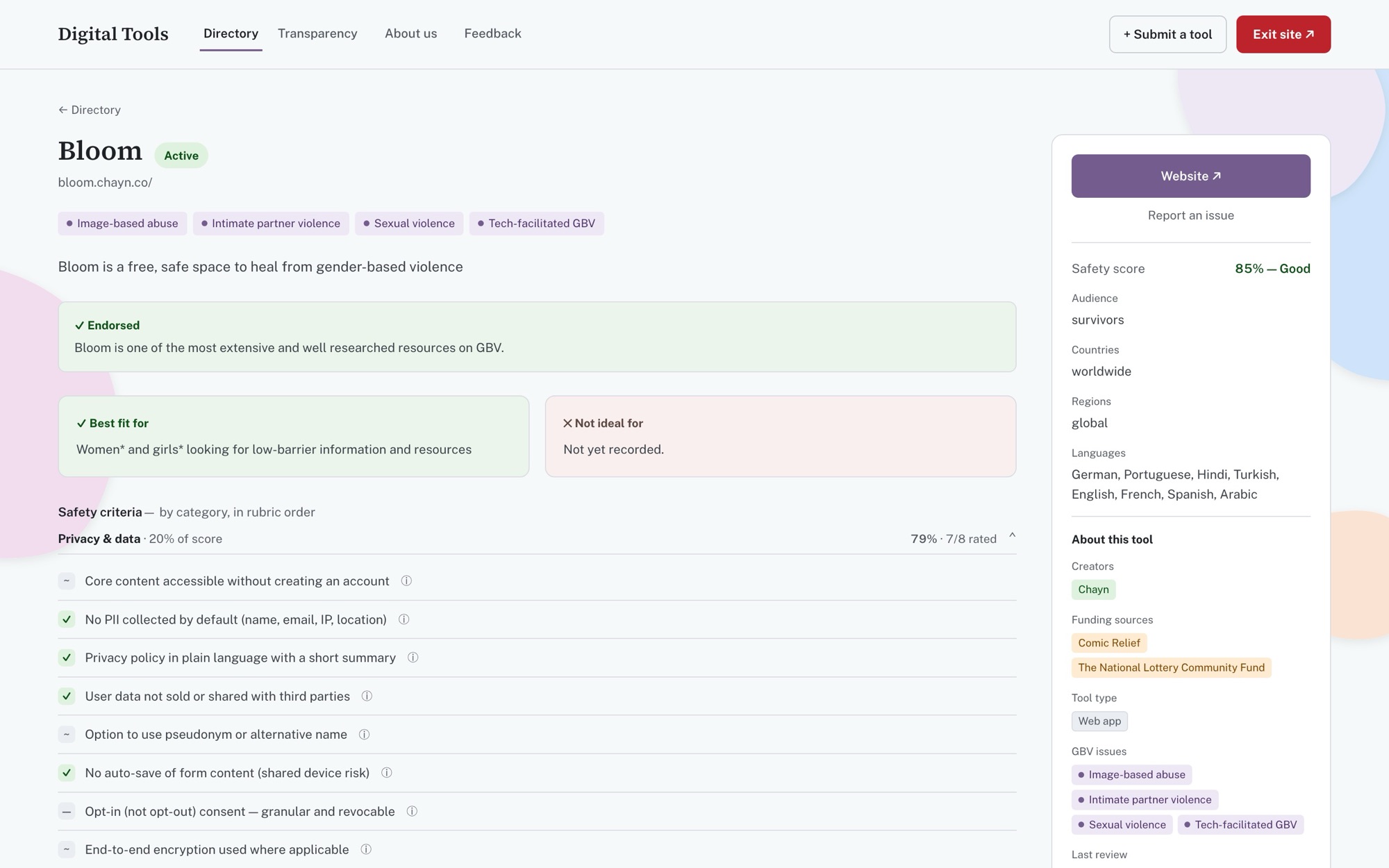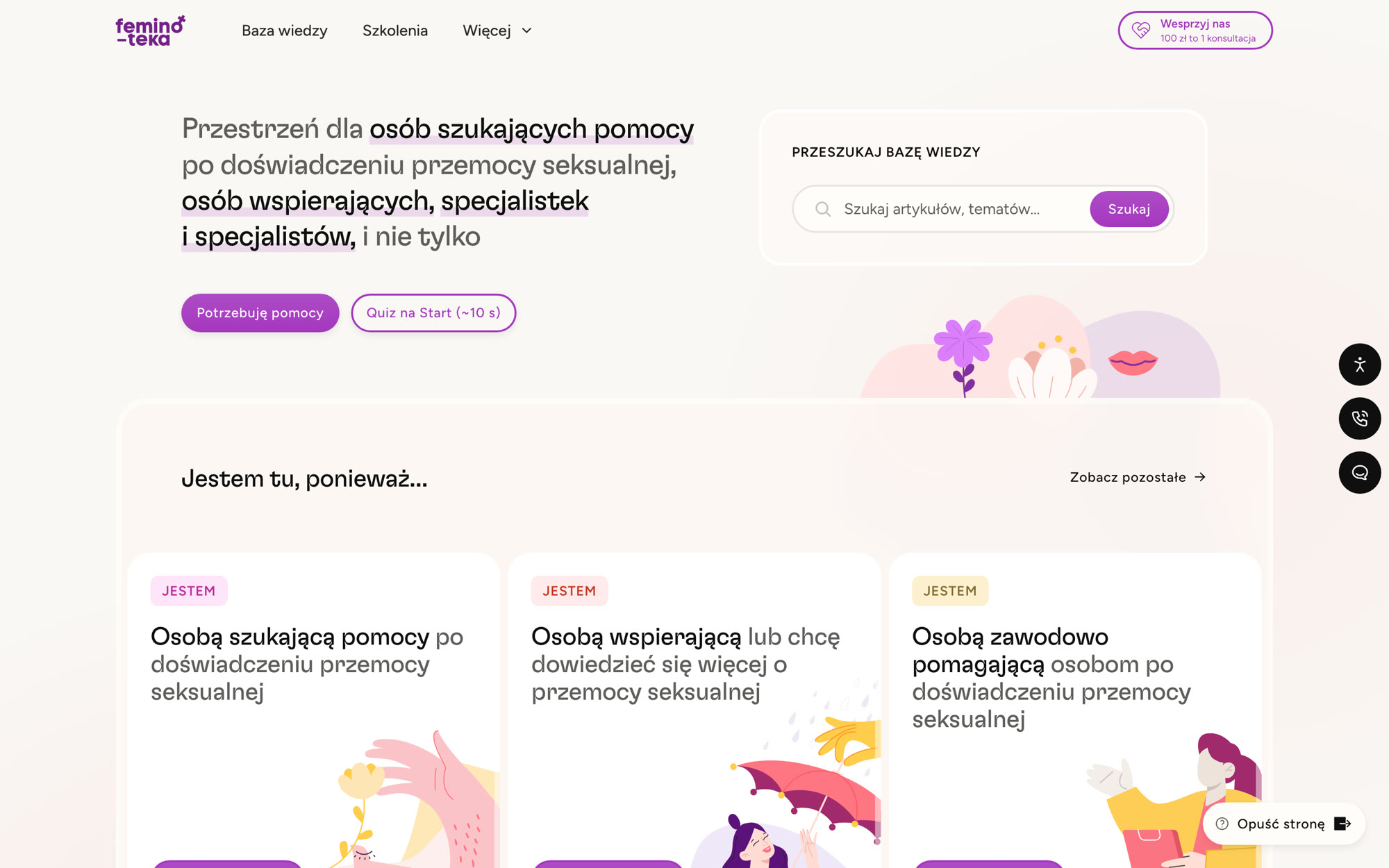
Feminoteka describes the platform as the first comprehensive portal on sexual violence in Poland: legal, psychological and medical knowledge in one place. It launches on 25 November 2026, at the start of the 16 Days of Activism against Gender-Based Violence.
Who it is for
The platform speaks to three groups, and each of them arrives with a different question. A person who has experienced violence wants to know what she can do now, what her rights are and where to find help. Someone who supports a person close to them, or simply wants to know more, is looking for what sexual violence is, how to respond to it and what to avoid. Professionals need guidance for their own work. The platform covers eight professional groups, among them the police, health care, psychology, law, social services and the media.
Nobody has to create an account or say who they are. Visitors choose a starting point, and can change it at any time.
How the content is organised
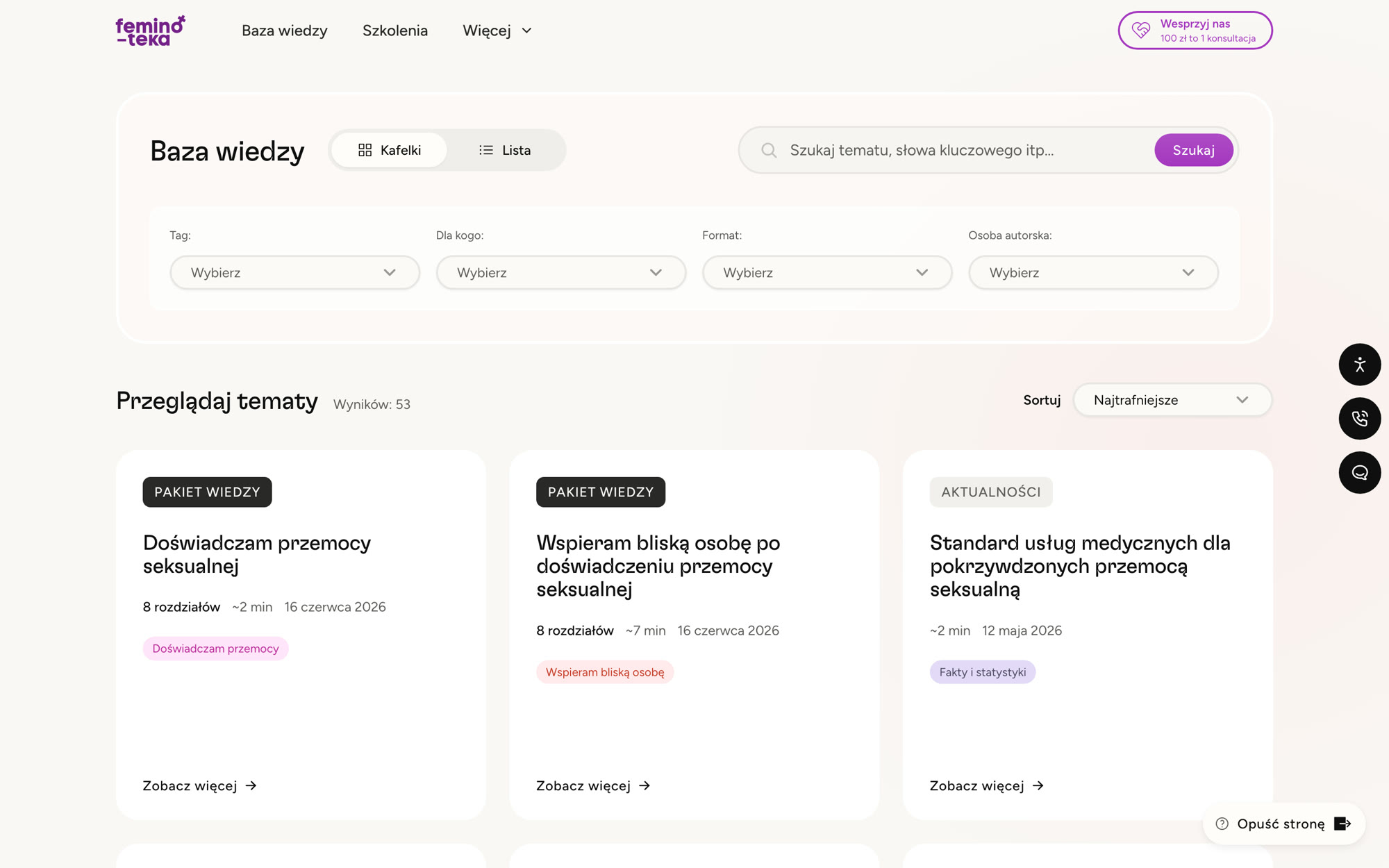
The basic unit is a section: a short piece of text with its own address and, where needed, its own content warning. Editors build two things from sections. The first is the knowledge base of articles, videos, infographics and downloads. The second is the knowledge packages: guides that lead one group of readers through a subject step by step. The same section can appear in an article and in several packages, so editors correct it once and the change shows everywhere.
- Knowledge packages The reader can stop, skip a step or come back later. Professionals see the parts written for their field.
- Search Full-text search across articles, quizzes and downloads. It runs in the visitor’s browser.
- Starter quiz A few questions that begin with “I am looking for…” and end with a link to the right page or package.
- Quizzes Knowledge tests, for example on consent, and self-assessment tests such as “Is this violence?”. The self-assessment tests give no score and no diagnosis.
- “I need help” page Helplines and support organisations. Phone numbers and opening hours come from one list that editors keep up to date.
Designed for people in crisis
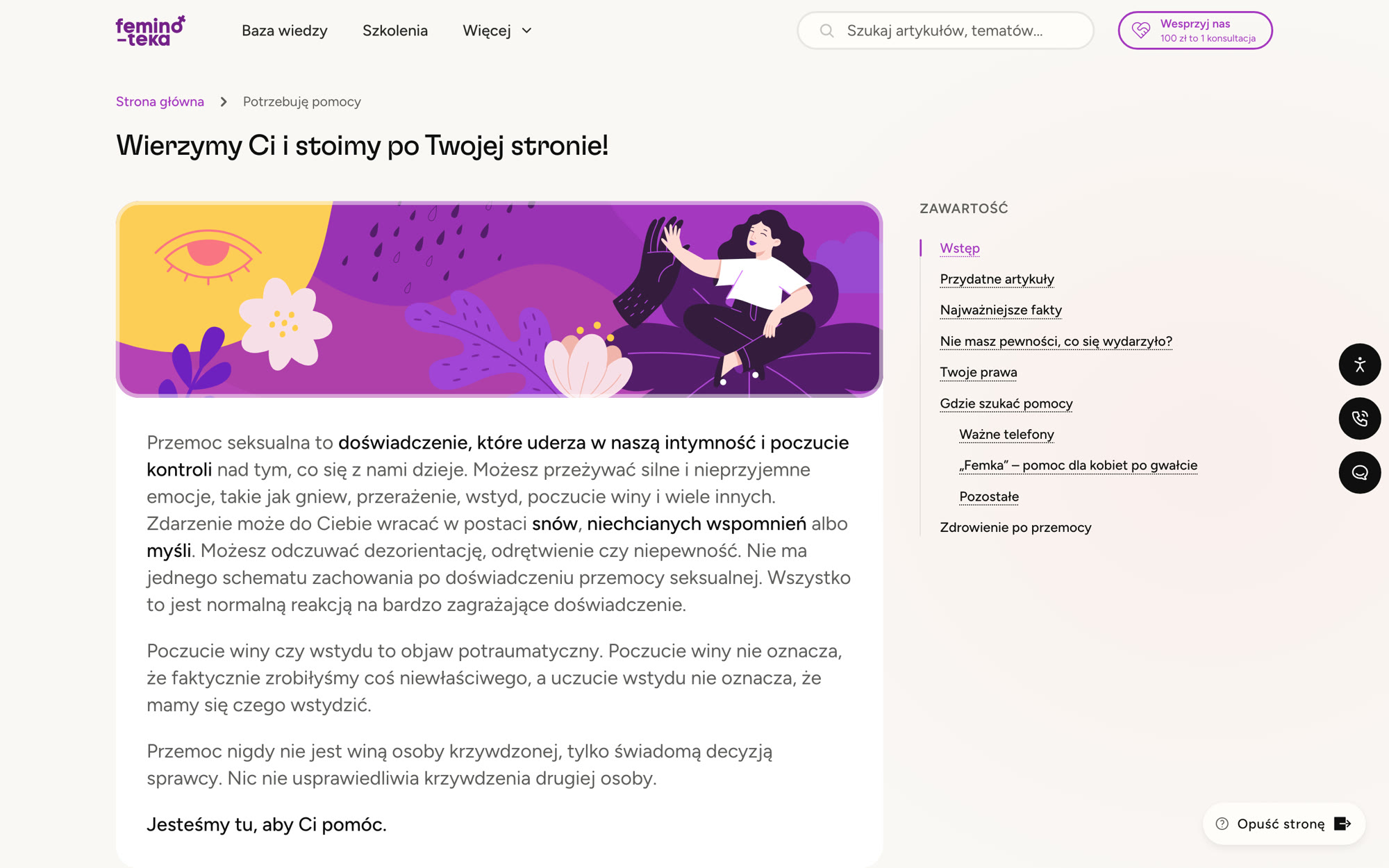
Some visitors are in crisis. Some use a phone or computer that another person controls. We followed the principles of trauma-informed design: the site is predictable, the reader stays in charge, nobody is asked to disclose anything, and nobody is labelled. Instead of “victims”, the platform speaks of people who have experienced violence, and it uses inclusive language.
Quick exit is on every page. The “Leave site” button, the Shift+Esc shortcut or pressing Shift three times replaces the platform with a neutral website and clears the reading and search history kept during the visit. The site says plainly what this does not do: it does not clear the browser history.
Content warnings appear before difficult material, at the level of a single section. Nothing plays automatically, and there is no graphic imagery.
The platform has no accounts, and its visit statistics do not track individual people. Fonts, images and files are served from the platform itself. Reading suggestions are worked out in the visitor’s browser from the pages opened during the visit, and nothing about them is sent to a server. Videos are the exception: they are embedded from YouTube, in its privacy-enhanced mode, or Vimeo.
Accessibility
The platform is built to the WCAG 2.2 AA standard. We check every page template with automated accessibility tests, on a wide screen and at a width of 320 pixels. Where the original colours did not give enough contrast, we darkened them.
An accessibility panel lets visitors enlarge the text, raise the contrast, underline links, turn off animations and switch to a font that is easier to read. Pages are generated ahead of time, so the main content appears in about two seconds even on a slow mobile connection.
How editors work
Feminoteka’s editors manage articles, sections, packages, quizzes and downloads themselves in Sanity Studio. They can preview drafts on a separate copy of the site before publishing. Every image must have alternative text, and every text can record who checked the facts and when. Articles end with a bibliography. Readers can rate a page with one click and add a comment, anonymously.
The site is built with Astro and Vue and hosted on Cloudflare Pages.
What comes next
The platform launches on 25 November 2026 at edu.feminoteka.pl. It starts in Polish. The interface is already translated into English and Ukrainian, ready for content in those languages.
We stay with the project after the launch: we maintain the platform and develop it together with Feminoteka’s editors.
Placeholder for a quote from Feminoteka Foundation about working on the platform.
Full name role, Feminoteka Foundation